
Psychedelics
Psychedelics represent the next great revolution in psychiatry. A class of molecules that includes LSD, psilocybin, and MDMA, the psychedelics are unique in that they offer a transformative treatment experience rather than a suppressive or disease-modifying one. While incredibly promising, these drugs are all still in various phases of research.
I am following this research closely, and in conjunction with industry leaders and the academic psychiatry community, hope to make these medications available to patients when they become safely available for clinical use. As of writing in late 2026, none of these compounds has achieved FDA approval, and all remain Schedule I controlled substances. This information remains purely educational and should not be construed as medical advice.
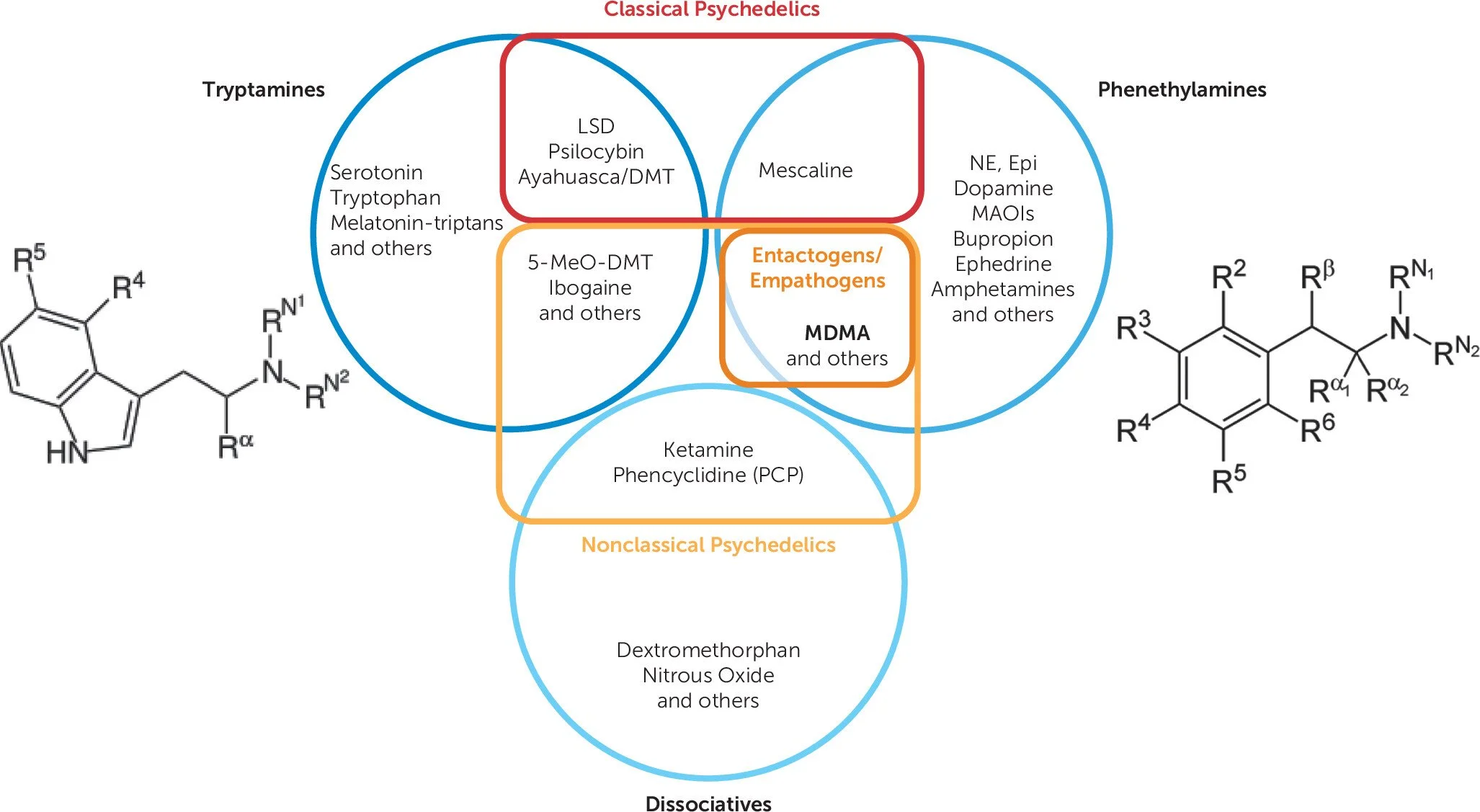
The various psychedelics and their classifications. Note that MDMA is more closely related to amphetamines and bupropion, while LSD and psilocybin relate more to the naturally occurring tryptamines in our bodies.
Wolfgang AS, Fonzo GA, Gray JC, Krystal JH, Grzenda A, Widge AS, Kraguljac NV, McDonald WM, Rodriguez CI, Nemeroff CB. MDMA and MDMA-Assisted Therapy. Am J Psychiatry. 2025 Jan 1;182(1):79-103. doi: 10.1176/appi.ajp.20230681. PMID: 39741438.
The Big 3
Currently there are three promising compounds in active clinical research, some of which may become commercially available in 2027 or 2028 if fully FDA-approved. These are, broadly speaking, LSD, psilocybin, and MDMA.
LSD-derived compounds
Lysergic acid diethylamide, or LSD, is a classical psychedelic that was first synthesized in 1938, meaning that it was made in a lab. Its psychedelic effects have been known since 1943 (after an accidental ingestion!). While initially studied for psychiatric usage, its association with the counterculture of the 1960s led to its ultimate classification as a Schedule I controlled substance in the US by 1970. This designation severely restricted further research into LSD’s potential benefits for decades, though it has always remained popular as a recreational drug. While the drug scheduling system in this country is useful, it has not always been applied properly: cannabis is still federally classified as Schedule I, too.
As an agonist of 5-HT2A serotonin receptors, LSD is known to cause visual disturbances, intense spiritual experiences, and ego dissolution. It has been studied for many clinical applications, including major depressive disorder, generalized anxiety disorder, and post-traumatic stress disorder.
The most promising formulation of LSD currently in the pharmaceutical pipeline is DT120 ODT, the proprietary formulation of lysergide (LSD) D-tartrate from Definium Therapeutics. Multiple concurrent clinical trials have explored uses of this compound in generalized anxiety disorder (GAD) and major depressive disorder (MDD).
In August 2026 Definium announced positive results from its randomized, double-blind, placebo-controlled Phase 3 study which evaluated a single dose of DT120 ODT 100µg in adults with GAD. In addition to meeting its primary endpoint, the drug was generally well-tolerated.
As a psychiatrist in outpatient practice, I not only want to know that a drug works well, but that it also does not cause harm or new problems. Thus far it seems that DT120 ODT occasionally may cause mild and transient treatment-emergent adverse effects, but nothing that represents persistent or chronic harm. Many early concerns about transient or post-treatment mania, psychosis, or suicidal ideation or behavior all now appear unfounded.
I am closely monitoring the trials that are yet to come from Definium, including an upcoming study looking at dose differences between 100µg and 50µg, compared to a placebo arm. If their previous dose-finding studies hold true, this next study should confirm the efficacy of the 100µg dose while simultaneously reinforcing that there is a threshold dose (which 50µg does not meet). I do suspect that there will be at least some separation from the 50µg and the placebo arm, but whether that is statistically significant remains to be seen.
In short, this is a very promising compound, and one that I hope to deliver to patients if future studies and FDA approval proceed without concern.
What does DT120 ODT look like for patients?
Interestingly, Definium has staked a claim on their compound working in and of itself. Much of the initial psychedelic treatment wave focused on psychedelic-assisted psychotherapy. DT120 ODT has been studied extensively on its own, without a possibly confounding and difficult-to-replicate psychotherapy component. That said, the protocol of the drug does require close observation throughout the course of the treatment by a qualified professional who can give guidance or reassurance when needed.
There will also be an associated REMS program so that patient data is nationally available, curbing any one individual’s ability to hop between clinics, receiving more doses than have been studied and approved.
What is exciting is that if the drug works, the fact that there is no associated need for psychotherapy will make this drug much easier to put into clinical use. It will also make it more affordable and accessible to patients. Hurdles will include the need for a full day (6-8 hours) in the treatment center to allow the drug to work and leave the system. Follow-up protocols are as yet undefined, as far as I know, though an experienced board-certified psychiatrist should be able to make recommendations in this regard based on an individual patient’s needs. I would also like to see more data on the duration of these positive outcomes, which can illuminate whether these responses represent true remission or will require more regular follow-up treatments.
Psilocybin
Psilocybin is a naturally occurring serotonergic psychedelic compound produced by over 200 species of fungi, historically utilized for centuries in indigenous ceremonial contexts. Isolated in 1958, psilocybin was evaluated in early mid-century psychiatric research before being categorized as a Schedule I controlled substance in 1970, with the same fate that befell LSD. More recent research has been slowly eroding this classification status, as it becomes clearer that psilocybin has the potential to help, rather than harm, when used appropriately.
Like LSD, psilocybin acts primarily as an agonist at 5-HT2A serotonin receptors, reducing activity in the default mode network (DMN). Patients typically experience perceptual alterations, profound emotional insights, and a temporary loosening of deeply ingrained depressive cognitive patterns.
The leading pharmaceutical formulation in development is COMP360, a proprietary, highly purified synthetic psilocybin developed by Compass Pathways. COMP360 has been investigated primarily for Treatment-Resistant Depression (TRD), a severe condition affecting millions who have failed two or more standard antidepressant regimens. While TRD is not a separate diagnosis in and of itself, as a descriptor it does capture a population of people who do not do well with standard antidepressants such as SSRIs and SNRIs. I believe that the TRD label inherently captures many people who have also been misdiagnosed, such as those with bipolar depression or other conditions that would not respond to standard antidepressants anyway. As always, a thorough diagnostic assessment remains vital.
Phase 3 pivotal trials (COMP005 and COMP006) evaluated the efficacy, safety, and durability of COMP360. Data demonstrated that a 25 mg dose administered in a clinical setting produced rapid, statistically significant reductions in depressive symptom severity (measured via the MADRS scale) compared to low-dose/control arms, with treatment response maintaining durability out to 6 months for a substantial portion of patients after just one or two sessions.
From an outpatient safety standpoint, COMP360 has demonstrated a generally well-tolerated profile. The vast majority of treatment-emergent adverse events were mild, occurred on the day of dosing and resolved within 24 hours. Serious adverse events remained low across large cohort populations.
What does COMP360 administration look like for patients?
Unlike trials evaluating standalone pharmacotherapies, the COMP360 protocol utilizes a model of psilocybin combined with structured psychological support. The administration occurs in a specialized, comfortable clinical room under the supervision of trained therapists or facilitators who provide preparation beforehand, acute monitoring during the 6-to-8-hour journey, and integration sessions afterward.
Commercial deployment of COMP360 will involve structured logistics:
Session Duration: Patients must allocate a full day (typically 6 to 8 hours) in an outpatient suite equipped for psychedelic monitoring.
Psychological Support Infrastructure: Practices will need trained clinical monitors on staff to facilitate the mandatory preparation, active session oversight, and post-session integration.
REMS and Scheduling: Approval will be coupled with a strict REMS program and is dependent on DEA rescheduling of psilocybin from Schedule I to a lower schedule.
If approved by the FDA, COMP360 will offer a vital, rapid-acting interventional option for patients who have exhausted traditional oral antidepressants, though integrating the required clinical staffing and monitoring space will be key operational considerations for outpatient psychiatric practices.
MDMA
MDMA (3,4-methylenedixoymethamphetamine) is different from the others in that it is not a classical psychedelic. Also known as ‘ecstasy’ or ‘molly,’ MDMA was first synthesized in 1912, though its psychoactive effects were unknown for many decades. In the 1960s, MDA (a similar molecule) was used in psychiatric treatment as an adjunct to psychotherapy, prior to its classification as Schedule I in 1970. MDMA rose in prominence shortly thereafter, and was used to treat thousands of patients throughout the 1970s and 1980s until its eventual classification as Schedule I as well, in 1985.
As MDMA does not work on the 5-HT2A receptor system, it does not cause a breakdown of ego functioning and perceptional lucidity is maintained. Additionally, it tends to create pro-social effects in the user, such as heightened trust and self-compassion. These differences are why MDMA is classified as an entactogen/empathogen rather than a classical psychedelic.
For a time it seemed that MDMA would be the first psychedelic to receive FDA approval, but that has yet to materialize. Lykos Therapeutics has been studying midomafetamine (the much shorter generic term for racemic MDMA) for use in assisted psychotherapy, much like psilocybin above. They looked specifically at treating PTSD. Despite initially promising results from their Phase 3 trials, in late 2024 the FDA declined to approve the drug in its current form, citing methodological concerns including functional un-blinding and inconsistent therapy protocols. While the compound is still in Phase 3 trials, these concerns essentially pushed back any approval by a few years.
Definium, the company that is developing DT120 ODT as above, also has its own version of MDMA in the pipeline: DT402, consisting of only the R-enantiomer of MDMA. Their hope seems to be that since the R-enantiomer is associated with more of the prosocial and empathatic effects of MDMA, and the L-enantiomer with its stimulant-like effects, this formulation will be safer but equally efficacious. As with their approach with LSD, Definium is studying this compound without a component of psychotherapy. Further studies are needed, and currently they are looking at this medication for potential use in those with autism spectrum disorder.
What does MDMA administration look like for patients?
As of writing, this remains unclear. If Lykos has success with their trials, implementation may look like the psilocybin model of psychedelic-assisted psychotherapy. If Definium is also successful, we may have an option for observed pharmacological use without an associated requirement for psychotherapy.
Compared to the classical psychedelics, MDMA does seem to have a greater potential for abuse. This makes sense when we consider its structural relation to amphetamines. For this reason we can expect MDMA to be offered only as an in-office treatment with strict regulatory requirements, and it may be scheduled higher than the other two. Special consideration should be given to those with a history of substance use disorders, especially stimulants, prior to initiating treatment.
| Compound & Developer | Mechanism & Classification | Target Indications | Psychotherapy Component? | Estimated Availability |
|---|---|---|---|---|
|
DT120 ODT (LSD) Definium Therapeutics |
Classical Psychedelic 5-HT2A Serotonin Receptor Agonist |
GAD, MDD (Future: PTSD) |
No Pharmacology alone; 6–8 hr in-clinic observation required |
2027 – 2028 Phase 3 trials (Positive 100µg GAD results in 2026) |
|
COMP360 (Psilocybin) Compass Pathways |
Classical Psychedelic 5-HT2A Serotonin Receptor Agonist (DMN Activity Reduction) |
Treatment-Resistant Depression (TRD) |
Yes Structured psychological support (prep, 6–8 hr journey, integration) |
2027 Phase 3 pivotal trials (COMP005 & COMP006) |
|
DT402 (R-enantiomer MDMA) Definium Therapeutics |
Entactogen / Empathogen Isolates (R)-enantiomer to reduce stimulant side effects |
Autism Spectrum Disorder (ASD) |
No Standalone observed pharmacological model |
2028+ Active clinical trials underway |
|
Midomafetamine (Racemic MDMA) Lykos Therapeutics |
Entactogen / Empathogen Monoamine Releaser (Pro-social / Trust Effects) |
PTSD |
Yes Manualized MDMA-assisted psychotherapy |
Delayed (2028+) Phase 3 ongoing following late-2024 FDA decision |
Summary
This is an exciting time for psychedelic research and psychiatry in general. Since the dawn of the SSRIs in the late 1980s and early 1990s, there have not been any advances in psychopharmacology which can be called truly revolutionary.
As you can see, none of these big three psychedelics are new. They have all been around for many decades, sometimes used clinically, sometimes researched, though for a great deal of time completely taboo after their classifications as Schedule I.
I hope that through continued rigorous research, these compounds can be brought into clinical practice. While SSRIs, mood stabilizers, and dopamine blockers are all useful and can be life-saving, it cannot be denied that they are not useful for everyone, and are often used simply because they are “better than nothing.” By bringing new medications to the forefront of clinical practice, we can help an even greater number of people. Provided that future studies reinforce the safety and efficacy of these compounds, we can hope to see their use begin in 2027 or 2028.